
AI didn’t become the magic button everyone thought it would be. It created a short-term rush, froze budgets, and left a lot of teams wondering why their results didn’t match the hype.
People pumped out content because the tools made it easy, but the results didn’t magically improve. Everyone was using the same prompts, the same templates, and the same half-baked strategies. Feeds filled up with lookalike posts that felt like they were written by the same tired intern.
That’s the real story. The problem isn’t AI. It’s that the gap between output and actual skill has never been more visible, and marketing teams are quietly feeling that pressure every day.
- 88% of marketers say they use AI every day
- The global AI marketing market is valued at $47.32B
- 93% of marketers report faster or more efficient content creation with AI
- AI-assisted content creation has increased 3x since 2022
In this post, I break down what this actually means for marketing teams, founders, and anyone trying to stand out instead of getting swallowed by flat results.
Why AI Didn’t Replace Marketers but Definitely Raised the Bar
AI didn’t wipe out marketing jobs. It just exposed where the real skill gaps were hiding. When the tools made output easy, it became painfully obvious who could think strategically and who was relying on volume.
Teams found out fast that AI can produce paragraphs, but it can’t build a narrative. It can summarize data, but it can’t decide what matters. It can draft content, but it can’t understand why a message lands or falls flat.
This is why companies didn’t suddenly need fewer marketers. They needed sharper ones.
Here’s what AI still can’t do well, no matter how good the model gets:
- Strategic judgment. Deciding which ideas, messages, and channels have a real shot at driving revenue.
- Original creative thinking. AI remixes patterns. It doesn’t create point-of-view, tension, or differentiation.
- Emotional nuance and buyer psychology. Humans buy based on meaning, story, and timing. Models don’t feel any of that.
- Cross-functional alignment. AI doesn’t gather sales, product, and leadership to fix mixed messaging.
- Long-term narrative direction. Brands don’t grow on templates. They grow on consistent clarity.
AI flattened the playing field at the bottom. It made the top stand out even more. The marketers who rely on shortcuts look the same. The ones who think creatively rise fast.
The Skills that Matter Most for Marketers
AI didn’t just change how marketers work. It exposed who was operating on tactics instead of real strategy. That shift shows up everywhere now like in job postings, hiring trends, performance reviews, and revenue conversations.
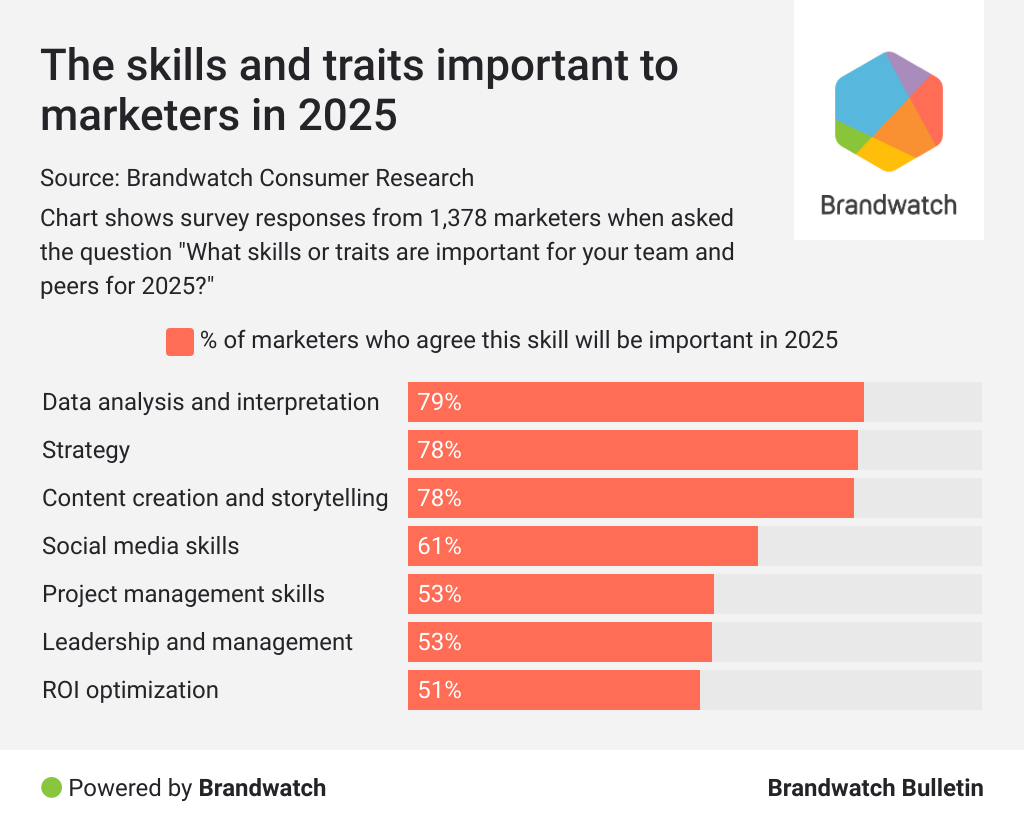
You can see the gap in the data. Teams aren’t looking for people who “know AI.” They’re looking for people who know how to think, decide, and interpret what the tools spit out.
Here’s what the numbers say about the skills rising to the top:
- 79% of marketers say data analysis is one of the most important skills today
- 74% of CMOs say strategic thinking is the #1 skill they’re prioritizing in new hires
- Soft skills like communication, creativity, and collaboration are rated more valuable than technical ability
- Demand for storytelling, positioning, and human-centered messaging continues to climb
All of that lines up with what you’re probably seeing on the ground. AI made content easier, so teams need people who can add meaning to it, not just speed.
Even in my own line of work, I’m watching VPs of Marketing and even CMOs struggle, especially the ones who built their careers on talking instead of executing.
The ground is shifting fast. AI accelerated that shift, but it’s not the only force. Buyer behavior, channels, attribution, content saturation, all of it changed at the same time.
If you can’t drive strategy and actually deliver results, you’re getting exposed. The playbooks that worked a year ago aren’t pulling their weight anymore.
What This Means for Founders, Agencies, and Small Teams
Budgets are tighter, expectations are higher, and patience is thin. When AI didn’t magically fix everything, leaders realized the real issue wasn’t the tools. It was the strategy steering them.
For founders and small teams, this shift hits even harder. You don’t have extra layers to hide behind. Every decision shows up in your pipeline, your brand, and your traction — good or bad.
Here’s the reality people rarely say out loud:
- Volume isn’t your problem. Clarity is. AI can help you publish more, but it can’t tell you what deserves to be published.
- You don’t need more content. You need direction. Teams are spending time on assets that don’t ladder into a bigger narrative.
- Hiring the wrong marketer (includes agencies and freelancers too) costs more now. If someone can’t interpret data, define strategy, or shape a message, the gap shows quickly.
- Execution matters more than tools. Anyone can run prompts. Not everyone can build a system that turns those prompts into pipeline.
The real edge for small teams isn’t speed or scale. It’s precision. When your narrative is sharp, every piece of content carries weight. When it isn’t, even ten AI assistants won’t save the campaign.
What I See When I Vet Marketing Talent
Working with companies across different industries gives me a front-row seat to how marketing teams actually operate. And lately, it’s obvious who’s built their career on real skill and who’s coasted on jargon and slide decks.
AI didn’t expose everyone at once. It exposed people slowly — in their decision-making, in their messaging, in how they handle pressure when the results don’t show up. The higher the title, the louder the gap rings.
This is what I pay attention to when I evaluate marketing talent, because these signals never lie:
- Can they explain their reasoning clearly? Not the tactics but the thinking behind them.
- Do they ask “why this” before asking “how much content?” Volume is a distraction. Intent is the lever.
- Can they interpret data in a way that shapes decisions? Not a dashboard tour. A point of view rooted in evidence.
- Do they shape narratives instead of chasing trends? Teams need consistency, not another copy of whatever’s trending this week.
- Are they willing to push back? Strategic marketers question assumptions instead of building campaigns on top of shaky ideas.
Founders and hiring managers feel this shift even if they don’t say it out loud. You can’t afford someone who looks good on LinkedIn but disappears when the real work starts. The market isn’t forgiving that anymore.
The Future Belongs to Sharp Thinkers
The next era of marketing won’t be shaped by people who crank out content faster. It’ll be shaped by the ones who understand how humans actually make decisions, how trust forms, and why certain messages create momentum while others evaporate.
AI will only make that gap more obvious. Not because it replaces marketers, but because it spotlights the difference between surface-level execution and real strategic depth. The separation isn’t human vs machine. It’s shallow thinking vs sharp thinking.
And that gap is widening by the day. If you know how to think, you’re stepping into the strongest leverage you’ve had in years.